Quick Formula :
- Permutations with Repetition : nr
- Permutations without Repetition :

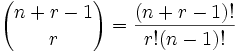
- Combinations with Repetition :
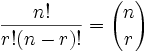
- Combinations without Repetition :
Permutations
There are basically two types of permutation:
- Repetition is Allowed: such as the lock above. It could be “333”.
- No Repetition: for example the first three people in a running race. You can’t be first and second.
1. Permutations with Repetition
These are the easiest to calculate.
When we have n things to choose from … we have n choices each time!
When choosing r of them, the permutations are:
n × n × … (r times)
n × n × … (r times) = nr
So, the formula is simply:
| nr |
| where n is the number of things to choose from, and we choose r of them (Repetition allowed, order matters) |
2. Permutations without Repetition
In this case, we have to reduce the number of available choices each time.
For example, what order could 16 pool balls be in?
After choosing, say, number “14” we can’t choose it again.
So, our first choice has 16 possibilites, and our next choice has 15 possibilities, then 14, 13, etc. And the total permutations are:
16 × 15 × 14 × 13 × … = 20,922,789,888,000
But maybe we don’t want to choose them all, just 3 of them, so that is only:
16 × 15 × 14 = 3,360
The formula is written:
| |
Combinations
There are also two types of combinations (remember the order does not matter now):
- Repetition is Allowed: such as coins in your pocket (5,5,5,10,10)
- No Repetition: such as lottery numbers (2,14,15,27,30,33)
2. Combinations without Repetition
This is how lotteries work. The numbers are drawn one at a time, and if we have the lucky numbers (no matter what order) we win!
The easiest way to explain it is to:
- assume that the order does matter (ie permutations),
- then alter it so the order does not matter.
Going back to our pool ball example, let’s say we just want to know which 3 pool balls are chosen, not the order.
We already know that 3 out of 16 gave us 3,360 permutations.
But many of those are the same to us now, because we don’t care what order!
For example, let us say balls 1, 2 and 3 are chosen. These are the possibilites:
| Order does matter | Order doesn’t matter |
| 1 2 3 1 3 2 2 1 3 2 3 1 3 1 2 3 2 1 |
1 2 3 |
So, the permutations will have 6 times as many possibilites.
In fact there is an easy way to work out how many ways “1 2 3” could be placed in order, and we have already talked about it. The answer is:
3! = 3 × 2 × 1 = 6
(Another example: 4 things can be placed in 4! = 4 × 3 × 2 × 1 = 24 different ways, try it for yourself!)
So we adjust our permutations formula to reduce it by how many ways the objects could be in order (because we aren’t interested in their order any more):
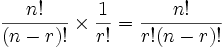
That formula is so important it is often just written in big parentheses like this:
| |
1. Combinations with Repetition
OK, now we can tackle this one …
Let us say there are five flavors of icecream: banana, chocolate, lemon, strawberry and vanilla.
We can have three scoops. How many variations will there be?
Let’s use letters for the flavors: {b, c, l, s, v}. Example selections include
- {c, c, c} (3 scoops of chocolate)
- {b, l, v} (one each of banana, lemon and vanilla)
- {b, v, v} (one of banana, two of vanilla)
(And just to be clear: There are n=5 things to choose from, and we choose r=3 of them.
Order does not matter, and we can repeat!)
This is like saying “we have r + (n-1) pool balls and want to choose r of them”. In other words it is now like the pool balls question, but with slightly changed numbers. And we can write it like this:
| |
 Memory Slate